SoloFury Fleet: Your Quota of Every Block Your Clients Find
Your clients keep their pool. With a small share of their hashrate they aim for a whole block. When one of them finds it, you receive your quota directly in the coinbase. No custody, no accounts, no invoices, zero cost for you.
Your clients keep mining in FPPS or PPLNS where they are now, with their steady income. A small share of their hashrate, the share they choose, goes to solo mining on SoloFury: a ticket for a whole block of 3.125 BTC plus fees.
In 30 seconds
- When a client in your fleet finds a block, the coinbase transaction pays three outputs: 1% to SoloFury, the quota you agreed with the client, the rest to the client.
- Apart from the SoloFury 1%, quotas are fully configurable, client by client.
- No custody, no accounts, no invoices. A fleet page with your logo, a page for every client, Telegram alerts.
- Cost to you: zero.
How it works
Client hashrate
├── larger part  → their FPPS/PPLNS pool   → regular payouts, as today
└── small part   → SoloFury Fleet (solo)    → if it finds a block, three-output coinbase:
                                               · 1% SoloFury (fixed)
                                               · manager quota (agreed with the client)
                                               · the rest to the client
Apart from the SoloFury 1%, quotas are fully configurable. You and the client decide them with your own agreement, and they can differ from client to client. SoloFury does not suggest or negotiate them: it applies the quota you communicate and writes it into the coinbase.
The solo share can be set up in two ways:
- Whole machines: one or more machines point at SoloFury Fleet. Works with any firmware.
- A percentage of every machine: with Braiins OS, pool groups split each machine’s hashrate in a fixed ratio between the usual pool and SoloFury. The client does not give up any machine.
What you gain
Today your clients’ block rewards never reach you: the pool collects them. With Fleet you receive your quota of every block found by any client in your fleet. Your clients’ solo shares add up: the more clients join, the more often a block arrives.
| Sum of the fleet’s solo shares | Expected blocks per year | At least 1 block in a year | Expected BTC per year, split between you and your clients |
|---|---|---|---|
| 5 PH/s | 0.28 | 24% | 0.85 BTC |
| 10 PH/s | 0.55 | 42% | 1.7 BTC |
| 20 PH/s | 1.1 | 67% | 3.4 BTC |
| 50 PH/s | 2.8 | 94% | 8.5 BTC |
| 100 PH/s | 5.5 | over 99% | 17 BTC |
Example: 100 clients with 2 PH/s each send one machine in ten to solo = 20 PH/s: one block expected per year. Calculated with difficulty 133 T (about 952 EH/s of network hashrate), reward 3.125 BTC minus the 1% pool fee, network fees excluded. These are averages: blocks arrive when they arrive.
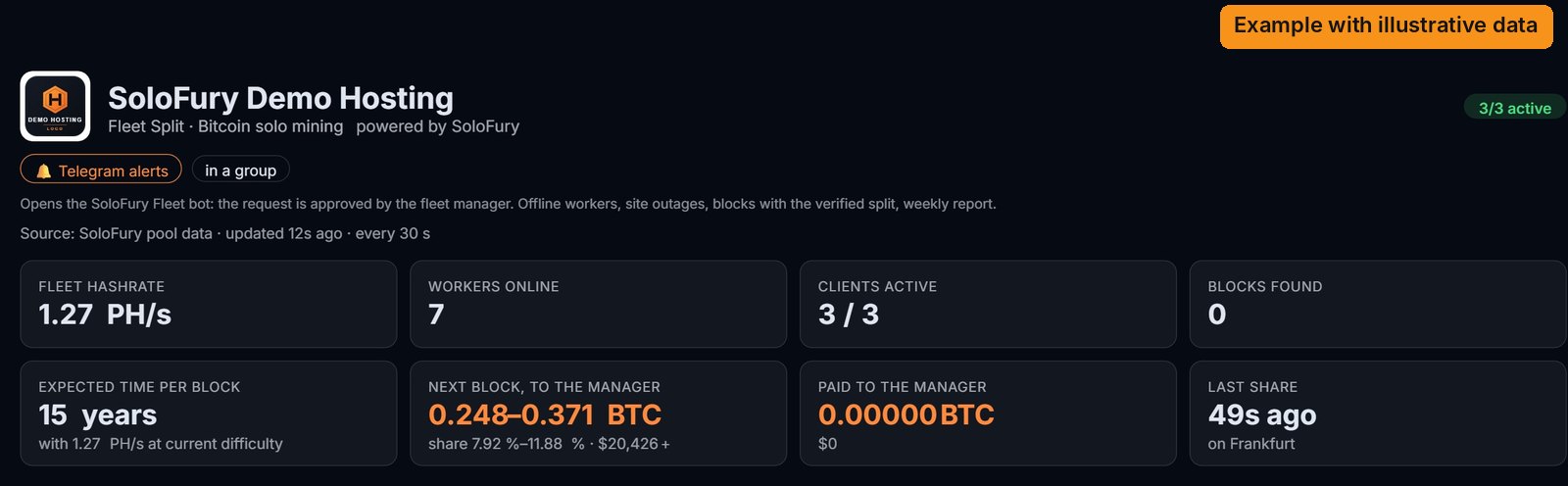
Your page, refreshed every 30 seconds (example with illustrative data: 3 clients, 5 Antminer S21 and 2 S19 XP):
What the client gains
- The steady income stays: the pool share pays as before.
- On the solo share they give up regularity, not value: over the long run the expected value is that of a pool, minus the difference in fees and the quota agreed with you.
- In exchange they get a real chance at a whole block:
| Client’s solo hashrate | Chance of a block in one year |
|---|---|
| 200 TH/s (one S21) | 1.1% (1 in 90) |
| 1 PH/s (five S21) | 5.4% (1 in 18) |
And the part they enjoy: their own page with hashrate, best share and the block split, Telegram alerts, and live proof that the next block’s coinbase already contains their address.
Why you can trust it
- Money passes through nobody. The pool writes the three outputs into the coinbase: the bitcoin is created directly in your wallet and the client’s.
- It can be verified before the block. A button on the client page shows the real coinbase of the next block, output by output, in satoshis. We know of no other pool that offers this.

- Every block has its proof. The SoloFury Block Info page and mempool.space, linked from the bot and the pages.
- The SoloFury 1% is fixed and untouchable, for everyone.
- Four regions (Atlanta, Frankfurt, Tokyo, São Paulo): the agreement is on every server, so failover keeps the split. Stratum V1 and V2.
What you need to do
- Send us your fleet name, page address, website, contact and a square SVG logo (or a 512 px PNG/WebP with transparent background). You sign a message from your wallet (Sparrow, Ledger, Electrum, Trezor): 2 minutes. Your page
solofury.com/fleet/<name>/goes live. - For each client who joins: a label, the quota you agreed, their address and their signature. We create the agreement and put it on every server, usually the same day.
- The client sets up their solo share: they copy username and port from the panel or scan the QR code. You connect them to Telegram with a QR code from the bot.
After that: nothing. Page, alerts, weekly report with CSV, and payouts run by themselves.
Try it now
- Demo manager page: solofury.com/fleet/demo/
- Telegram bot: @SoloFuryFleetBot
- Complete guide, for you and your clients: SoloFury Fleet — the complete guide
- Write to us: [email protected] (Telegram for quick questions: @Akira1980)
- Follow SoloFury on X: @SoloFuryPool
Zero cost, no lock-in. If a client wants to stop, they move their share elsewhere.
Frequently Asked Questions
What is SoloFury Fleet?
A program for hosting providers and farms: their clients send a small share of hashrate to solo mining on SoloFury, and every block found pays three outputs in the coinbase — 1% to SoloFury, the quota agreed between manager and client, and the rest to the client.
How much does SoloFury Fleet cost the hosting provider?
Nothing. There is no fee, no setup cost and no contract. SoloFury earns only its fixed 1% of the blocks found.
Who sets the manager's quota?
The manager and the client, with their own agreement. Apart from the SoloFury 1%, quotas are fully configurable and can differ from client to client.
Do clients have to leave their FPPS or PPLNS pool?
No. They keep most of their hashrate in their pool for steady income and send only the share they choose to solo: whole machines, or a fixed percentage of each machine with Braiins OS pool groups.
Does SoloFury hold the funds?
No. The three outputs are written into the coinbase transaction, so the bitcoin is created directly in the wallets of SoloFury, the manager and the client.
How can the split be verified?
Before any block: the client page has a button that reads the real template of the next block and shows the three outputs in satoshis. After a block: the SoloFury Block Info page and mempool.space.
Which machines can join SoloFury Fleet?
Any SHA-256 Bitcoin miner, from S19 and S21 to Bitaxe and NerdQaxe. Stock firmware works by pointing whole machines at Fleet; Braiins OS can also split each machine's hashrate by percentage. Stratum V1 and V2 are supported.
What does a client need to join?
A bc1q or bc1p address from a wallet that can sign messages, such as Sparrow, Ledger, Electrum or Trezor, and one signature to prove ownership. No account and no registration.